Showing posts with label Skyscrapers. Show all posts

Tuesday, July 8, 2008

WTC Building Seven - Seven Years Later


BUILDING SEVEN
COLLAPSED SEVEN HOURS AFTER THE TWIN TOWERS
SEVEN YEARS LATER The National Institute of Standards and Technology Decides To Release Its Findings

FROM THE BBC: 4 July 2008


9/11 third tower mystery 'solved'
By Mike Rudin BBC, Conspiracy Files

The final mystery of 9/11 will soon be solved, according to US experts investigating the collapse of the third tower at the World Trade Center.


The 47-storey third tower, known as Tower Seven, collapsed seven hours after the twin towers.

Investigators are expected to say ordinary fires on several different floors caused the collapse.

Conspiracy theorists have argued that the third tower was brought down in a controlled demolition. Unlike the twin towers, Tower Seven was not hit by a plane.

The National Institute of Standards and Technology, based near Washington DC, is expected to conclude in its long-awaited report this month that ordinary fires caused the building to collapse. That would make it the first and only steel skyscraper in the world to collapse because of fire.


The National Institute of Standards and Technology's lead investigator, Dr Shyam Sunder, spoke to BBC Two's "The Conspiracy Files": "Our working hypothesis now actually suggests that it was normal building fires that were growing and spreading throughout the multiple floors that may have caused the ultimate collapse of the buildings."

'Smoking gun'
However, a group of architects, engineers and scientists say the official explanation that fires caused the collapse is impossible. Architects and Engineers for 9/11 Truth argue there must have been a controlled demolition.

The founder of the group, Richard Gage, says the collapse of the third tower is an obvious example of a controlled demolition using explosives.

"Building Seven is the smoking gun of 9/11. A sixth grader can look at this building falling at virtually freefall speed, symmetrically and smoothly, and see that it is not a natural process.

"Buildings that fall in natural processes fall to the path of least resistance", says Gage, "they don't go straight down through themselves."


Conspiracy theories
There are a number of facts that have encouraged conspiracy theories about Tower Seven.

Although its collapse potentially made architectural history, all of the thousands of tonnes of steel from the skyscraper were taken away to be melted down.

The third tower was occupied by the Secret Service, the CIA, the Department of Defence and the Office of Emergency Management, which would co-ordinate any response to a disaster or a terrorist attack.

The destruction of the third tower was never mentioned in the 9/11 Commission Report. The first official inquiry into Tower Seven by the Federal Emergency Management Agency was unable to be definitive about what caused its collapse.

In May 2002 FEMA concluded that the building collapsed because intense fires had burned for hours, fed by thousands of gallons of diesel stored in the building. But it said this had "only a low probability of occurrence" and more work was needed.

But now nearly seven years after 9/11 the definitive official explanation of what happened to Tower Seven is finally about to be published in America.

The National Institute of Standards and Technology has spent more than two years investigating Tower Seven but lead investigator Dr Shyam Sunder rejects criticism that it has been slow.

"We've been at this for a little over two years and doing a two or two and a half year investigation is not at all unusual. That's the same kind of time frame that takes place when we do aeroplane crash investigations, it takes a few years."


With no steel from Tower 7 to study, investigators have instead made four extremely complex computer models worked out to the finest detail. They're confident their approach can now provide the answers. Dr Sunder says the investigation is moving as fast as possible.

"It's a very complex problem. It requires a level of fidelity in the modelling and rigour in the analysis that has never been done before."

Other skyscrapers haven't fully collapsed before because of fire. But NIST argues that what happened on 9/11 was unique.

Steel structure weakened
It says Tower Seven had an unusual design, built over an electricity substation and a subway; there were many fires that burnt for hours; and crucially, fire fighters could not fight the fires in Tower 7, because they didn't have enough water and focused on saving lives.

Investigators have focused on the east side where the long floor spans were under most stress. They think fires burnt long enough to weaken and break many of the connections that held the steel structure together.
Most susceptible were the thinner floor beams which required less fireproofing, and the connections between the beams and the columns. As they heated up the connections failed and the beams sagged and failed, investigators say.

The collapse of the first of the Twin Towers does not seem to have caused any serious damage to Tower Seven, but the second collapse of the 1,368ft (417m) North Tower threw debris at Tower Seven, just 350ft (106m) away.

Tower Seven came down at 5.21pm. Until now most of the photographs have been of the three sides of the building that did not show much obvious physical damage. Now new photos of the south side of the building, which crucially faced the North Tower, show that whole side damaged and engulfed in smoke.


OTHER SOURCES OF INFORMATION

BBC - Q&A: The collapse of Tower 7
The official version, the conspiracy theories and the evidence surrounding the collapse of World Trade Centre 7 on September 11.


NIST Comprehensive Presentation on Collapse of WTC 7 (pdf) (April 5, 2005)

Wednesday, June 11, 2008

9/11 & Freedom Tower Images, Photographs, Pictures & Graphics


THE IMAGES, PICTURES, PHOTOGRAPHS, GRAPHICS AND VIDEO, WHICH SHOCKED THE WORLD.
9 September 2001 - The Twin Towers & Pentagon


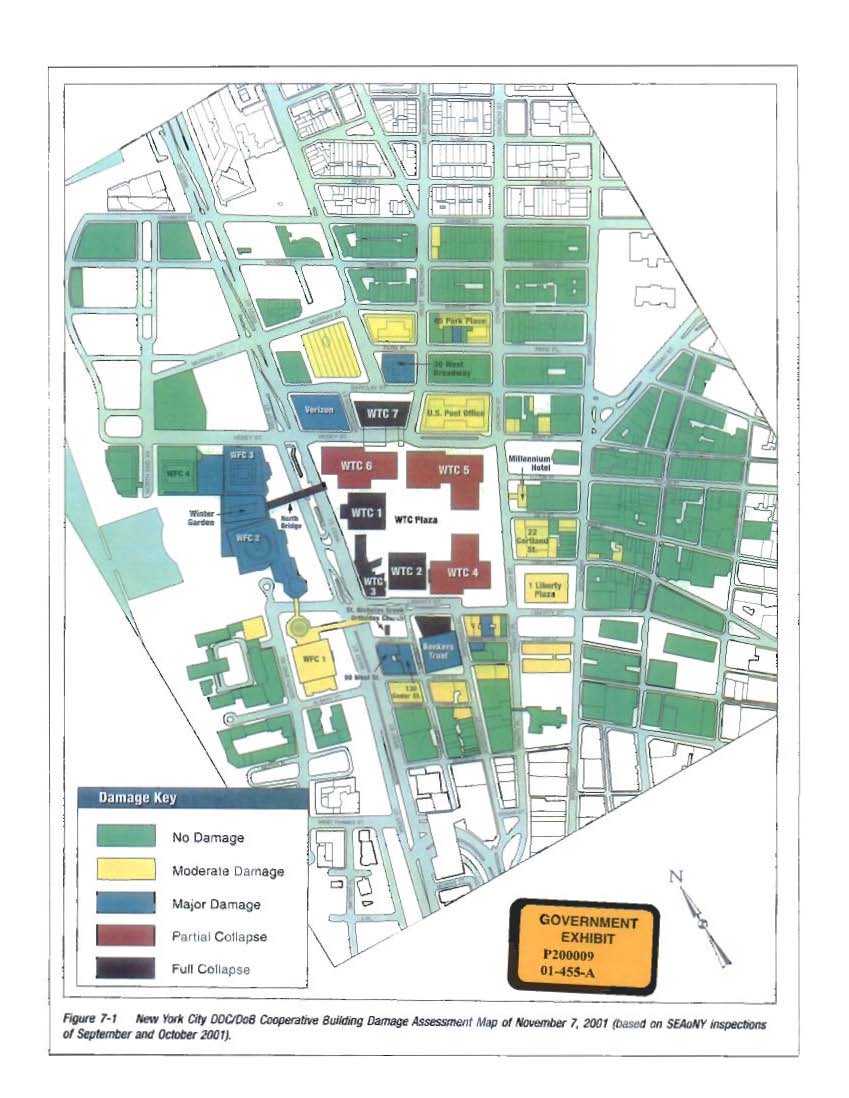
DAMAGE DONE TO THE WORLD TRADE CENTER COMPLEX
BLACK is Full Collapse
BROWN is Partial Collapse
BLUE is Major Damage
YELLOW is Moderate Damage
GREEN is No Damage
Hmmm.... WTC Building 7


THE FREEDOM TOWER


THE PENTAGON


AA-77 - Flight Path


OTHER SOURCES of Images, Pictures, Graphics, Photographs and Video
Christopher Casciano 72 Images - http://placenamehere.com/2001-09-11/
WASHINGTON POST Audio & Video Archive - http://www.washingtonpost.com/wp-srv/nation/specials/attacked/index_audiovideo.html
55 Images of 9/11 from Ultradio - http://www.ultradio.com/september11/
British GUARDIAN Newspaper Images - http://www.guardian.co.uk/gall/0,8542,550207,00.html
WASHINGTON POST Images http://www.washingtonpost.com/wp-srv/photo/attack/newyork/1.htm
TIME MAGAZINE Terror Hits Home Images http://www.time.com/time/photoessays/wtc/
WASHINGTON POST - Rebuilding the Pentagon Graphics http://www.washingtonpost.com/wp-srv/nation/graphics/attack/pentagon_7.html
Maps Relating to September 11, 2001 and Later Events - http://www.lib.utexas.edu/maps/wtc.html

Wednesday, June 4, 2008

Security/Intelligence Services - 9/11 Maths in Pictures!

SECURITY/INTELLIGENCE SERVICES WORLDWIDE, PLEASE COME FORWARD!

YOU KNEW about 9/11 BASIC MATHS in PICTURES and NUMEROLOGY.

This post presents some of the pictures of arithmetic/maths and numerology used for planning/displaying 9/11. The maths is elementary. Take a look for yourself.

We can SAFELY assume different Security/Intelligence Services checked the numbers in 9/11 and considered whether they might play a role later, in other Mass Casualty Incidents. So what did the Security Services actually know in advance of 11/3, 7/7 and 11/7, based on Maths and Numerology? Everyone has access to the pictures.....

I have listed below UN member states with their date of admission to the UN and some of the security/intelligence agencies connected with these countries. The UN Date of Admission list was taken from http://www.un.org/News/Press/docs/2006/org1469.doc.htm. [Notes] can be found there.

Seven Angels Are About To Arrive, Are They? Or, Are They Already Here?!

There were Seven Churchgates in Mumbai as well ........

NB I don't do Religion.

* * * * *


The Twin Towers had a Building Value of 2/II/Two/Twins


The Pentagon has a Building Value of 5/V/Five/Pentagon


If these buildings were hit because of their Numerical Value then V+II=VII, 2+5=25/7, 11+5=16, etc. What do Satellite Images show from above? What were/are these buildings called? Perhaps one building was more important (complete destruction) than the other (cosmetic destruction).

On 9/11 the total value of buildings hit was 7/VII/Seven. The number seven also appears

Look at the Flight Numbers and the Total by Airline

AA11 > 1 + 1 = 2
UA175 > 1 + 7 + 5 = 13 / 1 + 3 = 4
AA77 > 7 + 7 = 14 / 1 + 4 = 5
UA93 > 9 + 3 = 12 / 1 + 2 = 3


AA11 (2) + AA77 (5) = 7 (American Airlines) (Mirror Letters/Numbers = AA, 11 & 77)

UA175 (4) + UA93 (3) = 7 (United Airlines)


* * *

Only Odd Numbers Appear In Dates and Flight Numbers

AA11, UA175, AA77 & UA93 : 1, 1, 1, 3, 5, 7, 7, 7, 9

* * *

Look at Airport Codes for Departure and Arrival of Flights

Depart - Arrive
BOS Boston - LAX Los Angeles
IAD Washington - LAX Los Angeles
EWR Newark - SFO San Francisco

Departures: BOS, IAD, EWR Airports - Anglo Roots
Arrivals: LAX, SFO - Spanish, French & Religious Roots

Only LAX Los Angeles flights hit buildings, with a total value of seven. Could be calculated as 7 Angels.

* * *

If the following list of countries and security apparatus can not/refuse to explain these (bizarre) observations to the global population, they are either unconcerned about these Terrorism Attacks or Covering Up/Protecting the Perpetrators, so they can attack The Innocent again.

A
UN DATE OF ADMISSION
Afghanistan - 19 November 1946 / Albania - 14 December 1955 / Algeria - 8 October 1962 / Andorra - 28 July 1993 / Angola - 1 December 1976 / Antigua and Barbuda - 11 November 1981 / Argentina - 24 October 1945 / Armenia - 2 March 1992 / Australia - 1 November 1945 / Austria - 14 December 1955 / Azerbaijan - 2 March 1992


INTELLIGENCE SERVICES
Afghanistan - National Directorate of Security (NDS) / Albania - State Intelligence Service (SHISH) / Algeria -Département du Renseignement et de la Sécurité / Argentina - Secretaría de Inteligencia (SI) (Secretariat of Intelligence) (former SIDE) & Escuela Nacional de Inteligencia (ENI) (National Intelligence School) & Inteligencia de la Policía de Seguridad Aeroportuaria (Airport Security Police Intelligence) / Australia - Australian Security Intelligence Organisation (ASIO) & Australian Secret Intelligence Service (ASIS) & Defence Imagery and Geospatial Organisation (DIGO) / Austria - Heeresnachrichtenamt (HNA) (Army Intelligence Office) / Armenia - National Security Service (NSS) / Azerbaijan - Milli Tehlukesizlik Nazirliyi (MTN) (Ministry of National Security)


B
Bahamas - 18 September 1973 / Bahrain - 21 September 1971 / Bangladesh - 17 September 1974 / Barbados - 9 December 1966 / Belarus
[1] - 24 October 1945 / Belgium - 27 December 1945 / Belize - 25 September 1981 / Benin - 20 September 1960 / Bhutan - 21 September 1971 / Bolivia - 14 November 1945 / Bosnia and Herzegovina[2] - 22 May 1992 / Botswana - 17 October 1966 / Brazil - 24 October 1945 / Brunei Darussalam - 21 September 1984 / Bulgaria - 14 December 1955 / Burkina Faso - 20 September 1960 / Burundi - 18 September 1962
Bangladesh - Directorate General of Forces Intelligence (DGFI) / Belgium
Staatsveiligheid / Sûreté de l'État (SV/SE) (State Security Service) & Algemene Dienst Inlichting en Veiligheid / Service Général du Renseignement et de la Sécurité (ADIV/SGRS) (General Information and Security Service) / Brazil - Agência Brasileira de Inteligência (ABIN) (Brazilian Intelligence Agency) / Bulgaria - Nacionalen komitet za sigurnost (NKS) (Committee for State Security)

C
Cambodia - 14 December 1955 / Cameroon - 20 September 1960 / Canada - 9 November 1945 / Cape Verde - 16 September 1975 / Central African Republic - 20 September 1960 / Chad - 20 September 1960 / Chile - 24 October 1945 / China - 24 October 1945 / Colombia - 5 November 1945 / Comoros - 12 November 1975
Congo (Republic of the) - 20 September 1960 / Costa Rica - 2 November 1945 / Côte d’Ivoire - 20 September 1960 / Croatia
[3] - 22 May 1992 / Cuba - 24 October 1945 / Cyprus - 20 September 1960 / Czech Republic[4] - 19 January 1993
Canada - Canadian Security Intelligence Service (CSIS) & Communications Security Establishment (CSE) &
Canadian Forces Intelligence Branch (DND) / China - Ministry of State Security (MSS) Chinese: Guojia Anquan Bu (Guoanbu) / Chile - Agencia Nacional de Inteligencia (ANI) (National Intelligence Agency) / Colombia - Departamento Administrativo de Seguridad (DAS) (Administrative Department of Security) / Cuba - Dirección General de Inteligencia (DGI) (General Directorate of Intelligence) & Revolutionary Armed Forces Intelligence / Czech Republic - Bezpečnostní informační služba (BIS) (Security Information Service)

D
Democratic People’s Republic of Korea - 17 September 1991 / Democratic Republic of the Congo
[5] - 20 September 1960 / Denmark - 24 October 1945 / Djibouti - 20 September 1977 / Dominica - 18 December 1978 / Dominican Republic - 24 October 1945
Denmark - Politiets Efterretningstjeneste (PET) (Police Intelligence Service) & Forsvarets Efterretningstjeneste (FE) (Defence Intelligence Service) / Democratic Republic of the Congo - Agence nationale de renseignements

E
Ecuador - 21 December 1945 / Egypt
[6] - 24 October 1945 / El Salvador - 24 October 1945 / Equatorial Guinea - 12 November 1968 / Eritrea - 28 May 1993 / Estonia - 17 September 1991 / Ethiopia - 13 November 1945
Egypt - Mabahith Amn al-Dawla al-'Ulya (State Security Investigation Bureau ) / Estonia - Kaitsepolitseiamet (KAPO) (Security Police Board)

F
Fiji - 13 October 1970 / Finland - 14 December 1955 / France - on 24 October 1945
Finland - Suojelupoliisi (Supo) (Protection Police) & Viestikoelaitos (VKoeL) (literally Signals Test Facility), the signals intelligence agency of the Finnish Army / France - Direction Centrale des Renseignements Généraux (RG) (Central Directorate of General Intelligence)

G
Gabon - 20 September 1960 / Gambia - 21 September 1965 / Georgia - 31 July 1992 / Germany
[7] - 18 September 1973 / Ghana - 8 March 1957 / Greece - 25 October 1945 / Grenada - 17 September 1974 / Guatemala - 21 November 1945 / Guinea - 12 December 1958 / Guinea-Bissau - 17 September 1974 / Guyana - 20 September 1966
Germany - Bundesnachrichtendienst (BND) (Federal Intelligence Service) & Militärischer Abschirmdienst (MAD) (Military Protective Service) & GSG 9 / Greece - Ethniki Ypiresia Pliroforion (NIS) (Hellenic National Intelligence Service)

H
Haiti - 24 October 1945 / Honduras - 17 December 1945 / Hungary - 14 December 1955
Hungary - Nemzetbiztonsági Hivatal (NBH) (National Security Office)

I
Iceland - 19 November 1946 / India - 30 October 1945 / Indonesia
[8] - 28 September 1950 / Iran - 24 October 1945 / Iraq - 21 December 1945 / Ireland - 14 December 1955 / Israel - 11 May 1949 / Italy - 14 December 1955
Iceland - Greiningardeild Ríkislögreglustjóra (National Security Agency) & Greiningardeild Varnarmáladeildar (Military Intelligence Service) (also known as the Icelandic Intelligence Service and IIS) / India - Intelligence Bureau (IB) / Defense Intelligence Agency (DIA) & Central Bureau of Investigation (CBI) / Indonesia - Badan Intelijen Negara (BIN) / Iran - Ministry Of Intelligence (MOIS) / Iraq - General Security Directorate (Iraq) (GSD) & Iraqi National Intelligence Service (INIS) / Ireland - G2 (Military Intelligence) & Special Detective Unit (formerly Special Branch) of the Garda Síochána / Israel - ha-Mossad le-Modiin u-le-Tafkidim Myukhadim (Mossad) (Institute for Intelligence and Special Operations) & Sherut ha-Bitakhon ha-Klali (Shabak or Shin Bet)(General Security Service) & Agaf ha-Modi'in (Aman) (Military Intelligence) / Italy - Comitato Esecutivo per i Servizi di Informazione e Sicurezza (CESIS) (Executive Committee for Intelligence and Security Services) & Servizio per le Informazioni e la Sicurezza Militare (SISMI) (Military Intelligence and Security Service)

J
Jamaica - 18 September 1962 / Japan - 18 December 1956 / Jordan - 14 December 1955
Japan - Cabinet Intelligence and Research Office (Naicho) & Ministry of Defense / Jordan - Da’irat al-Mukhabarat al-’Ammah (GID) (General Intelligence Department)

K
Kazakhstan - 2 March 1992 / Kenya - 16 December 1963 / Kiribati - 14 September 1999 / Kuwait - 14 May 1963 / Kyrgyzstan - 2 March 1992
Kenya, Republic of - National Security Intelligence Service (NSIS) / Korea, Republic of - National Intelligence Service (NIS)

L
Lao People’s Democratic Republic - 14 December 1955 / Latvia - 17 September 1991 / Lebanon - 24 October 1945 / Lesotho - 17 October 1966 / Liberia - 2 November 1945 / Libya - 14 December 1955 / Liechtenstein - 18 September 1990 / Lithuania - 17 September 1991 / Luxembourg - 24 October 1945


M
Madagascar - 20 September 1960 / Malawi - 1 December 1964 / Malaysia
[9] - 17 September 1957 / Maldives - 21 September 1965 / Mali - 28 September 1960 / Malta - 1 December 1964 / Marshall Islands - 17 September 1991 / Mauritania - 27 October 1961 / Mauritius - 24 April 1968 / Mexico - 7 November 1945 / Micronesia (Federated States of) - 17 September 1991 / Monaco - 28 May 1993 / Mongolia - 27 October 1961 / Montenegro[10] - 28 June 2006 / Morocco - 12 November 1956 / Mozambique - 16 September 1975 / Myanmar - 19 April 1948
Republic of Macedonia - Agencija za razuznavanje (Intelligence Agency) IA / Malaysia - Kor Risik DiRaja (Royal Intelligence Corps) / Maldives - Maldives National Defence Force (MNDF) / Mexico - Centro de Investigación y Seguridad Nacional (CISEN) (National Security and Investigation Center) / Moldova - Serviciul de Informaţii şi Securitate al Republicii Moldova (SIS) (Information and Security Service of the Republic of Moldova)

N
Namibia - 23 April 1990 / Nauru - 14 September 1999 / Nepal - 14 December 1955 / Netherlands - 10 December 1945 / New Zealand - 24 October 1945 / Nicaragua - 24 October 1945 / Niger - 20 September 1960 / Nigeria - 7 October 1960 / Norway - 27 November 1945
Netherlands - Algemene Inlichtingen- en Veiligheidsdienst (AIVD) (General Intelligence and Security Service) & Militaire Inlichtingen- en Veiligheidsdienst (MIVD) (Military Intelligence and Security Service) / New Zealand - Government Communications Security Bureau & Security Intelligence Service / Nigeria - State Security Service (SSS) / National Intelligence Agency (NIA) / Norway - Nasjonal sikkerhetsmyndighet (NSM) (National Security Authority) & Etterretningstjenesten (NIS) (Norwegian Intelligence Service)

O
Oman - 7 October 1971

P
Pakistan - 30 September 1947 / Palau - 15 December 1994 / Panama - 13 November 1945 / Papua New Guinea - 10 October 1975 / Paraguay - 24 October 1945 / Peru - 31 October 1945 / Philippines - 24 October 1945 / Poland - 24 October 1945 / Portugal - 14 December 1955
Pakistan - Inter-Services Intelligence (ISI) & Intelligence Bureau (IB) & Military Intelligence (MI) & Special Branch (SB) / Peru - Servicio de Inteligencia Nacional (SIN) (National Intelligence Service) / Philippines - National Intelligence Coordinating Agency (NICA) &National Bureau of Investigation (NBI) / Poland - Agencja Wywiadu (AW) (Foreign Intelligence Agency) & Agencja Bezpieczeństwa Wewnętrznego (ABW) (Internal Security Agency) / Portugal - Sistema de Informações da República Portuguesa (SIRP) (Intelligence System of the Portuguese Republic)

Q
Qatar - 21 September 1971


R
Republic of Korea - 17 September 1991 / Republic of Moldova - 2 March 1992 / Romania - 14 December 1955 / Russian Federation
[11] - 24 October 1945 / Rwanda - 18 September 1962
Romania - SRI (Romanian Intelligence Service) / Russian Federation - Federalnaya Sluzhba Bezopasnosti (FSB) (Federal Security Service) & Federalnoye Agentstvo Pravitelstvennoy Svyazi i Informatsiyi (FAPSI) (Federal Agency of Government Communications and Information) & Glavnoye Razvedyvatelnoye Upravlenie (GRU) (Main Intelligence Directorate) & Sluzhba Vneshney Razvedki (SVR) (Foreign Intelligence Service)


S
Saint Kitts and Nevis - 23 September 1983 / Saint Lucia - 18 September 1979 / Saint Vincent and the Grenadines - 16 September 1980 / Samoa - 15 December 1976 / San Marino - 2 March 1992 / Sao Tome and Principe - 16 September 1975 / Saudi Arabia - 24 October 1945 / Senegal - 28 September 1960 / Serbia
[12] - 1 November 2000 / Seychelles - 21 September 1976 / Sierra Leone - 27 September 1961 / Singapore - 21 September 1965 / Slovakia[13] - 19 January 1993 / Slovenia[14] - 22 May 1992 / Solomon Islands - 19 September 1978 / Somalia - 20 September 1960 / South Africa - 7 November 1945 / Spain - 14 December 1955 / Sri Lanka - 14 December 1955 / Sudan - 12 November 1956 / Suriname - 4 December 1975 / Swaziland - 24 September 1968
Switzerland - 10 September 2002 / Sweden - 19 November 1946 / Syria
[15] - 24 October 1945
Saudi Arabia - Al Mukhabarat Al A'amah (General Intelligence Directorate) / Serbia - Bezbednosno Informativna Agencija (BIA) (Security Information Agency) / Singapore - Internal Security Department (ISD) & Security and Intelligence Division (SID) / Slovakia - Slovenská informačná služba (SIS) (Slovak Information Service) & Národný bezpečnostný úrad (NBÚ) (National Security Bureau) / Slovenia - Slovenska Obveščevalno-Varnostna Agencija (SOVA) (Slovenian Intelligence and Security Agency) / South Africa - National Intelligence Agency (NIA) & South African Secret Service (SASS) / Spain - Centro Nacional de Inteligencia (CNI) (National Intelligence Centre) & Spanish Army (Centro de Inteligencia de las Fuerzas Armadas) / Sweden - Militära underrättelse- och säkerhetstjänsten (MUST) (Military Intelligence and Security Directorate) & Säkerhetspolisen (SÄPO) (Security Service) / Switzerland - Strategischer Nachrichtendienst (SND) (Strategic Intelligence Service) & Dienst für Analyse und Prävention (DAP) (Analysis and Prevention Service) & Militärischer Nachrichtendienst (MND) (Military Intelligence Service)

T
Tajikistan - 2 March 1992 / Thailand - 16 December 1946 / The former Yugoslav Republic of Macedonia
[16] - 8 April 1993 / Timor Leste - 27 September 2002 / Togo - 20 September 1960 / Tonga - 14 September 1999 / Trinidad and Tobago - 18 September 1962 / Tunisia - 12 November 1956 / Turkey - 24 October 1945 /
Turkmenistan - 2 March 1992 / Tuvalu - 5 September 2000
Taiwan - National Security Bureau & National Police Agency & Ministry of National Defense / Turkey - Milli Istihbarat Teskilati (MIT) (National Intelligence Organization) & Jandarma Istihbarat ve Terorle Mücadele (JITEM) (Gendarmerie Intelligence and Counter-Terrorism Bureau) & Milli Güvenlik Kurulu Genel Sekreterliği (MGK) (National Security Council) / Turkmenistan - Committee for National Security (KNB)

U
Uganda - 25 October 1962 / Ukraine - 24 October 1945 / United Arab Emirates - 9 December 1971 / United Kingdom - 24 October 1945 / United of Republic of Tanzania
[17] - 14 December 1961 / United States - 24 October 1945 / Uruguay - 18 December 1945 / Uzbekistan - 2 March 1992
Ukraine - Central Intelligence Directorate — Holovne Upravlinnya Rozvidky (HUR) & Security Service of Ukraine — Sluzhba Bezpeky Ukrayiny (SBU) / United Kingdom - Secret Intelligence Service (SIS or colloquially MI6) & Security Service (colloquially MI5) & Government Communications Headquarters (GCHQ) & Defence Intelligence Staff (DIS) & Intelligence Corps / United States - Central Intelligence Agency (CIA) & United States Department of Defense & Military Intelligence & Defense Intelligence Agency (DIA) & National Security Agency (NSA) & Office of Intelligence and Counterintelligence & United States Secret Service & Office of Intelligence and Analysis / Uzbekistan - Milliy Havfsizlik Hizmati (National Security Service)

V
Vanuatu - 15 September 1981 / Venezuela - 15 November 1945 / Viet Nam - 20 September 1977
Venezuela - Dirección de los Servicios de Inteligencia y Prevención (DISIP) (Directorate of Intelligence and Prevention Services) / Vietnam - Tổng cục 2 tình báo quân đội (TC2) (Second Central Commission of Military Intelligence)

Yemen
[18] - 30 September 1947


Z
Zambia - 1 December 1964 / Zimbabwe - 25 August 1980
Zimbabwe - Central Intelligence Organisation (CIO)

Thursday, April 3, 2008

Pre 9/11 WTC History of Security Reviews and Terrorism Assessments

Pre 9/11 WTC History of Security Reviews and Terrorism Assessments
Be Proactive!..... What If.....Plan for the Worst Case Scenario and Save Lives

This post focuses on the New York Port Authority Departments with personnel, intelligence agencies and external consultants who were engaged in security matters and responsible for assessing security threats at the WTC, prior to the 2001 attack.

A few newspaper articles mention acts of concern one week prior to the attack, such as a power down in the South Tower and the removal of explosive sniffer dogs, however the authenticity of this information remains questionable.


HISTORY OF SECURITY ASSESSMENTS OF WORLD TRADE CENTER THROUGH 2001

EXTRACTED FROM World Trade Center Bombing Litigation - 2004 NY Slip Op 24030 [3 Misc 3d 440] January 20, 2004 - Supreme Court, New York County ttp://www.courts.state.ny.us/reporter/3dseries/2004/2004_24030.htm

& COOPERATIVE RESEARCH HISTORY COMMONS http://www.cooperativeresearch.org

The WTC was run by the World Trade Department of the Port Authority, which determined whether to open parts of the WTC to the public, whether public parking should be offered and what security should be provided for the buildings and the garage. Civilian management personnel had responsibility for the day-to-day administration of security guards assigned to the WTC. The Port Authority Police had a command post on the B-1 level, and were responsible for public safety. The civilian security guards were not police officers, did not carry weapons or handcuffs, and reported to the World Trade Department, not to the Port Authority Police. They provided security, were information agents (providing information and directions to the public), monitored access to the complex, reported accidents to the police, and detected intruders. The police were responsible for criminal investigations and accidents.

The Port Authority Establishes a Terrorism Planning Office
In the early 1980's the Port Authority was aware of terrorist activities occurring in other areas of the world, and that the WTC, as a highly symbolic target, was vulnerable to terrorist attack. In fact, the Port Authority recognized that, in 1983-1984, two thirds of domestic terrorist incidents occurred in the New York-New Jersey metropolitan region.

In response, the Port Authority created a Terrorist Planning and Intelligence Section, and assigned Detective Sergeant Peter Caram the tasks of identifying terrorist groups and Port Authority targets, and to assess the vulnerability of Port Authority facilities to terrorist attack. The Terrorist Planning Section submitted its report in 1984, in which it warned that the threat of domestic terrorism was rising, that the WTC was vulnerable to terrorist attack, and that the underground public parking garage was highly vulnerable, easily accessible, and, if attacked, could critically affect the WTC's infrastructure.

In another report, entitled "Terrorist Assessment—World Trade Center—1984" prepared at the request of the Port Authority Superintendent of Police, the Port Authority was warned that, more than at any time in its history, the WTC should be considered a prime target for domestic and international terrorists. The report also specifically warned that the parking lots "are accessible to the public and are highly susceptible to car bombings."

Later that year, again in 1984, the Port Authority created the Office of Special Planning (OSP) to address and evaluate the vulnerabilities of Port Authority facilities to terrorist acts, and to formulate recommendations to prevent and minimize the risks of such acts. Port Authority Executive Director Peter Goldmark, in a memorandum to Vic Strom, Director of the Port Authority's Public Safety Department, Edward O'Sullivan, Director of OSP, and Hank DeGeneste, the Assistant Superintendent of Port Authority Police, noted the particular concern the authorities at Scotland Yard expressed to Port Authority officials in August 1984, about the vulnerability of the WTC parking garage to terrorist attack.

The OSP staff included Port Authority civilian or police personnel with experience in terrorism, operational security, tactical technology, bomb investigation, operations, and military operations. OSP's Director, Mr. O'Sullivan, was experienced in terrorism and counter-terrorism from his 10-year career in the Navy and Marine Corps. OSP's mission was "to study and prepare measures which would make Port Authority facilities less vulnerable to terrorist attack, to improve the organization's prevention and defensive capabilities, to establish liaison with foreign and domestic units engaged in counter-terrorism activities and to develop an awareness among staff of the potential terrorist threat and the need for vigilance and preparedness. "

OSP consulted with the FBI, the CIA, the National Security Agency, United States Secret Service, United States Department of Transportation, Department of State, Department of Defense, and security officials from the governments of France, England, Italy, Switzerland and Israel, as well as private consultants. The scope of OSP's activities included reviewing and addressing vulnerabilities, identifying alternatives and solutions, presenting recommendations to the facility's management, and obtaining responses from each facility that would be coordinated with the Director of Public Safety.

OSP's Study of the WTC
The OSP spent four to six months studying the WTC, including its building design through examination of photographs, blueprints, diagrams, and plans. OSP brought in experts, such as those who built the WTC, and those who operated it, as well as experts familiar with sabotage and explosives, and had them walk through to assess what was vulnerable, and identify critical areas of the WTC that, if damaged, could impair the building's ability to function or require it to shut down. The OSP visited other large commercial buildings in the City, reviewing their security and the way they handled and responded to bomb threats.

To formulate its recommendations, OSP conducted a "target analysis" in which it analyzed Port Authority targets in terms of "criticality, accessibility, vulnerability, recuperability and extended effect that destruction of the specific target" would have. Criticality is the measure of the impact on the normal flow of events by the target's destruction. Accessibility refers to the terrorist's ability to reach and attack a vincible point. Vulnerability is the extent to which the target would be damaged. Recuperability is the speed at which normal operation would resume after an attack. Finally, OSP evaluated the extended effect of destruction of the target.
In a preliminary report entitled "WTC Study Brief", OSP staff considered several attack scenarios, including, most significantly, a "bomb-laden truck attack." In the report, it was stated that, given the recent truck bombings in Lebanon, it was important to consider this possibility, and that a "strategically positioned truck or van could cause extensive structural damage to the Trade Center as well as a large number of casualties." OSP raised questions about this scenario, including which areas, i.e., across the street or in the parking lot below, provide the greatest "bang for the buck," what security exists for a truck bombing at WTC, and what other security measures against this scenario are viable.

In 1985, before the OSP issued its report, the Port Authority hired an outside security consultant, Charles Schnabolk, to review the WTC's security systems. Schnabolk's report focused on the threat of terrorism to the WTC. Schnabolk, in a letter to O'Sullivan, urged that action be taken as soon as possible to implement his recommendations. In the report, the terrorist threat of "bombing attempts" was placed in the "probable" category, and the report warned that the WTC "is highly vulnerable through the parking lot . . . With little effort terrorists could create havoc without being seriously deterred by the current security measures."

The OSP Report
In November 1985, OSP issued its report entitled "Counter-Terrorism Perspectives: The World Trade Center" (the OSP Report). The OSP Report recognized that the WTC was a "most attractive terrorist target" based on its symbolic value, its visibility, and the fact that it is immediately recognizable to people from around the world. The report listed 25 bombing incidents that took place in and around New York City from 1980-1984, including several car bombing incidents. It also listed a bombing at the beginning of 1985 in an office building just a few blocks from the WTC, and the Port Authority was aware of three bombs that had been placed in downtown buildings in August of 1985. " The underground public parking garage was particularly singled out as a "definite security risk."

In proposing potential terrorist scenarios at the WTC, the OSP Report predicted nearly precisely how the February 26, 1993 bombing would occur: "A time bomb-laden vehicle could be driven into the WTC and parked in the public parking area. The driver could then exit via an elevator into the WTC and proceed with his business unnoticed. At a predetermined time, the bomb could be exploded in the basement. The amount of explosives used will determine the severity of damage to the area."

OSP's Director, O'Sullivan, testified terrorists conduct surveillance of potential targets to determine the one with the greatest impact with the least risk to themselves, they can be deterred if they get a sense that the facility is protected, guarded, and presents some risk to them. The OSP Report was submitted to the Executive Director of the Port Authority, the Director of Public Safety of the Port Authority, the Superintendent of the Port Authority Police, and the Director of the World Trade Department.

Port Authority's Actions with Respect to OSP's Recommendations
Guy Tozzoli, the Director of the World Trade Department, in February 1986, in a letter to Stephen Berger, the Port Authority's Executive Director, addressed the OSP's recommendations. With respect to the subgrade levels and OSP's recommendation to ensure proper venting of smoke evacuation devices, Tozzoli responded that adequate ventilation was being provided by the subgrade exhaust fans. As to the public parking recommendations, Tozzoli responded that: (1) the elimination of transient parking would not be implemented, because of the inconvenience to tenants and the loss of revenues; (2) manning the public parking would be too expensive and would not deter a terrorist; (3) restricting pedestrians is impractical because there are many other ways to gain access to the areas; and (4) random inspections of vehicles could not be done without probable cause.

The SAIC Report
The Port Authority sought a second opinion about the OSP's recommendations, and hired an outside consultant, Science Applications International Corporation (SAIC), to conduct a general security review of the WTC. SAIC was given a copy of the OSP Report as well as Tozzoli's letter to Berger rejecting OSP's recommendations about the subgrade level. SAIC's Report rated the attractiveness of the WTC's public areas to terrorist attack as "very high." It identified the vehicle ramps as vulnerable areas. It specifically noted that vehicle access for security purposes is uncontrolled. The report found that a "well-placed vehicle bomb in each of these locations [the vehicle ramps] would likely damage at least half of the support services (fresh water, steam, cooling water, electrical and telephone) to the WTC users." The SAIC Report found that an adversary would have "little difficulty" in procuring explosives which are "readily available" in the quantities envisioned in the report. Like the OSP Report, the SAIC Report described an attack scenario, remarkably like the one which occurred, in which a small delivery truck with explosives could be positioned on a ramp to the complex, and detonated following a short time delay for the driver's escape.

In SAIC's presentation to the Port Authority's Executive Director in October 1986, SAIC featured "barriers to deter car bomb attempts" at a cost of $83,000, as an upgrade "for immediate implementation" to counter a terrorist attack, with a risk reduction figure of 40%. The presentation also included a comparison of OSP's recommendations about eliminating parking, or instituting more stringent controls and monitoring, and SAIC's recommendation that these actions were "considered but not recommended" based on discussions with the Port Authority.

The Burns and Roe Securacom Report
In 1991, because of the Gulf War and the increased risk of terrorism to United States targets, the Port Authority commissioned another security consulting firm, Burns and Roe Securacom, to prepare reports. Securacom was told by the Port Authority that the WTC was a terrorist target, and the report would help it plan its capital expenditures to maintain its competitive status with nearby buildings that offered more advanced security features. Securacom's draft report recognized that in the "aftermath of MidEast events," there would be a significant increase in "international activities." It included the subgrade utilities and the parking garage as areas of vulnerability. Its final report recommended that the WTC adopt a master plan approach to the development of security systems.

On January 23, 1993, one month before the bombing, the Port Authority received an intelligence report from the FBI that there was a threat from the MidEast to blow up a major office building in New York. Some heightened security measures were implemented over that weekend (Jan. 23 was a Friday) as a result, including some increased patrols around the perimeter, which patrols also drove through the underground areas, but these were scaled back after the weekend was over.

The Bombing
On February 26, 1993, at 12:18 p.m., a bomb exploded beneath the WTC, on the B-2 level of the underground parking garage, on a ramp that leads toward an exit from the garage. The explosion had the force of 1,500 pounds of dynamite. The investigation revealed that the bomb had been detonated in a yellow van parked on the ramp of the public parking garage. Six people were killed, and many, many more were injured, mostly from smoke inhalation. There was evidence that the perpetrators had made several surveillance visits to the garage, and drew maps of the garage. The explosion made a crater six stories deep, compressed several levels of concrete slab, blew down a wall onto the PATH concourse, and destroyed the walls of a number of elevator shafts. The explosion destroyed the communications system, the police area and operations control center, and vital utility systems, including water and electrical, and fire standpipes. Because of the loss of the operations control center, the Port Authority lost the ability to communicate with tenants and their employees in the complex, and to institute its emergency evacuation procedures.

In 1993 Kroll Associates, an investigative and security consulting firm headquartered in New York, was asked by the Port Authority of New York and New Jersey, the owner and manager of the World Trade Center at the time, to assist it in dealing with the aftermath of the terrorist bombing that took place in February of that year and to help design new security measures. This report's Principal Investigator, Brian Michael Jenkins, was then Deputy Chairman of Kroll and led the analysis of future terrorist threats and how they might be addressed. Assessments conclude that a second terrorist attack against the WTC is probable. Although it is considered unlikely, the possibility of terrorists deliberately flying a plane into the WTC towers is included in the range of possible threats

In October 1996, A security company called Stratesec acquires an $8.3 million contract to help provide security at the World Trade Center. This Firm has connections with the Bush Family. It is one of numerous contractors hired in the upgrade of security at the WTC following the 1993 bombing. Stratesec, which was formerly called Securacom, is responsible for installing the “security-description plan”—the layout of the electronic security system—at the World Trade Center. It has a “completion contract” to provide some of the center’s security “up to the day the buildings fell down,” according to Barry McDaniel, its CEO from January 2002. Marvin P. Bush, the youngest brother of future President George W. Bush, is a director at Stratesec from 1993 to June 2000, when most of their work on these big projects is done. Wirt D. Walker III, a distant relative of George W. Bush, is chairman of the board at Stratesec from 1992, and its CEO from 1999 until January 2002. Another of Stratesec’s directors, from 1991 to 2001, is Mishal Yousef Saud Al Sabah, who is a member of the Kuwaiti royal family. After 9/11 Stratesec CEO Barry McDaniel is asked whether FBI or other agents have questioned him or others at Stratesec about their security work related to 9/11. He answers, “No.”

After being awarded the lease to the WTC, SILVERSTEIN PROPERTIES offered John Patrick O'Neill (FBI's Counterterrorism Head) the post of Chief/Head of Security at the WTC in 2001. He retired from the FBI on 22 August 2001 and commenced work at the WTC either on 23 August or 10 September 2001 (sources differ). He was recommended for the post by MD Jerome Jauer, Kroll Associates.

* * * * * *

Various sources highlight Acts of Concern during the week leading up to 11 Septemer 2001.

Heightened Security Alert Had Just Been Lifted By Curtis L. Taylor and Sean Gardiner - NEWSDAY STAFF WRITERS - September 12, 2001 http://www.newsday.com/news/nationworld/nation/ny-nyaler122362178sep12,0,1255660.story

The World Trade Center was destroyed just days after a heightened security alert was lifted at the landmark 110-story towers, security personnel said yesterday. Daria Coard, 37, a guard at Tower One, said the security detail had been working 12-hour shifts for the past two weeks because of numerous phone threats. But on Thursday (6th), bomb-sniffing dogs were abruptly removed. "Today was the first day there was not the extra security," Coard said. "We were protecting below. We had the ground covered. We didn't figure they would do it with planes. There is no way anyone could have stopped that." Security guard Hermina Jones said officials had recently taken steps to secure the towers against aerial attacks by installing bulletproof windows and fireproof doors in the 22nd-floor computer command center.

"When the fire started, the room was sealed," said Jones, who was in the command center when explosions rocked the building. "Flames were shooting off the walls....We started putting wet towels under the doors. The Fire Department unsealed the door and grabbed us by the hand and said, 'Run!' " Security worker Diane Easton said she was out front writing tickets when notice of "a plane flying too low" placed security personal on alert. "The plane went right through the building...and debris started falling everywhere, then 15 minutes later the second plane," Easton said. Nancy Joyner said several police officers were knocked down and then were stampeded in the ensuing frenzy." People were flying out of the windows; there was nothing we could do," Joyner said. "People were pulled from the top floors by the wind tunnel created."

K-9 UNIT - The Port Authority Police Department formed its K-9 (police dog) Explosive Detection Unit in the fall of 1996 in response to the crash of TWA Flight 800 off the coast of Long Island that summer. The department subsequently expanded the unit to include a K-9 Narcotics Detection Unit. The K-9 unit, which consists of 45 police officers, three sergeants, one inspector and 48 dogs, patrols all Port Authority facilities on a 24-hour basis. The dogs are trained to detect either explosives or narcotics, but not both. The unit currently has 40 dogs trained to detect explosives, including 22 certified by the federal Transportation Security Administration. Sirius, PAPD Badge #17, died in the collapse of the World Trade Center on September 11, 2001.

Other quotes have been widely circulated on the internet however I have not tested their authenticity.

Ben Fountain, 42, a financial analyst with Fireman's Fund, was coming out of the Chambers Street Station, headed for his office on the 47th floor of the south tower: "How could they let this happen? They knew this building was a target. Over the past few weeks, we'd been evacuated a number of times, which is unusual. I think they had an inkling something was going on." Evacuated?

Scott Forbes, an IT employee at Fiduciary Trust located in top floors of the South WTC tower, sends an email to a 9/11 researcher John Kaminski claiming that there was a "power down" in the South Tower, which would have disabled all security cameras and locks, on Sept. 8th and 9th for "cable upgrading" that lasted approximately 36 hours from floor 50 up and that many "engineers" were coming in and out of the building.